
Surjeet Singh captain, Naveen Kumar deputy: the real question in Ahmedabad is Iran's absence
**मुख्य उत्तर:** भारतीय पुरुष कबड्डी टीम की कमान सुरजीत सिंह को मिली है और नवीन कुमार उपकप्तान हैं। 23–31 अक्टूबर 2026 को अहमदाबाद के वीर सावरकर स्पोर्ट्स कॉम्प्लेक्स में होने वाली कॉमनवेल्थ कबड्डी चैंपियनशिप में पुरुष और महिला दोनों वर्ग हैं; ईरान कॉमनवेल्थ सदस्य नहीं होने से बाहर है। **मुख्य तथ्य:** - सुरजीत सिंह कप्तान, नवीन कुमार उपकप्तान; घोषणा Khel Now रिपोर्ट में। - टूर्नामेंट 23–31 अक्टूबर 2026, अहमदाबाद; यह पहला संस्करण है। - पुरुष और महिला दोनों स्पर्द्धाएं; महिला कप्तान, स्क्वाड या कोच का जिक्र नहीं। - ईरान गैर-कॉमनवेल्थ; भारत के सबसे बड़े प्रतिद्वंद्वी की अनुपस्थिति। - रिपोर्ट में फॉर्मेट, टीमों की संख्या, स्क्वाड और ब्रॉडकास्टर नहीं दिए गए। **स्रोत:** Khel Now, कप्तानी घोषणा रिपोर्ट; प्रकाशन तिथि रिपोर्ट में उपलब्ध नहीं। **संबंधित प्रश्न-उत्तर:** Q: क्या भारत इस टूर्नामेंट का फेवरिट है? A: हां, क्योंकि ईरान जैसा असली चैलेंजर नहीं है और भारत की स्टैंडर्ड-स्टाइल गहराई सबसे आगे है। Q: सुरजीत-नवीन की कप्तानी जोड़ी क्यों? A: डिफेंडर कप्तान कोर्ट का पूरा नजारा देखता है और रेडर उपकप्तान हमले का टेम्पो संभालता है। Q: महिला टीम की क्या जानकारी है? A: रिपोर्ट में सिर्फ महिला वर्ग का जिक्र है; कप्तान, स्क्वाड या फॉर्मेट नहीं दिया गया।
The first raid at Ahmedabad's Veer Savarkar Sports Complex will be on 23 October 2026. Before that, the captaincy announcement is already out: Surjeet Singh as captain, Naveen Kumar as vice-captain. Khel Now's report is clear on that. The biggest line, though, does not carry Surjeet's name. This tournament will be played without Iran—and in kabaddi, Iran's absence is a bigger story than any captaincy announcement. The Commonwealth Kabaddi Championship 2026 is the inaugural edition. India is host. There are men's and women's competitions. The report says India will enter as title contenders. Here comes the first jolt: the report calls the event 'inaugural' in one place and talks about India winning 'back-to-back titles' in another. An inaugural edition cannot be won back-to-back. It looks like a small slip, but it says a lot about the health of the coverage.
To understand captaincy in kabaddi, you first have to understand the mat. Seven players, a 13x10 metre court, a raider who enters the opposition half within 30 seconds, the mandatory 'kabaddi-kabaddi' cant, and a return to his own half for the touch to count. In a tackle, defenders stop the raider. When an entire team is out, the opposition gets two bonus points and the eliminated team returns—that is an All Out. The bonus line gives one point, the third empty raid becomes a mandatory-scoring Do-or-Die raid, and a tackle with three or fewer defenders is a Super Tackle worth two points. Inside these rules, the captain's job is not a speech; it is live micro-decision-making: when to call a time-out, when to take a Do-or-Die risk, when to break an All Out threat, how to shift corner cover.
The cleanest PKL template is a defender-captain with a raider-vice-captain. The defender-captain sees the whole court in front of him during the opposition's raid—the best tactical vantage point. The raider-vice-captain controls the tempo of his team's scoring phases. The Surjeet-Naveen pairing fits that structure. But the report reduces it to 'defensive experience plus attacking ability'. What position does Surjeet play—cover, corner, something else? What is his PKL franchise? Home state? All three questions are open. Surjeet Singh is not a unique name in kabaddi; a national captaincy announcement should at least anchor the identity.
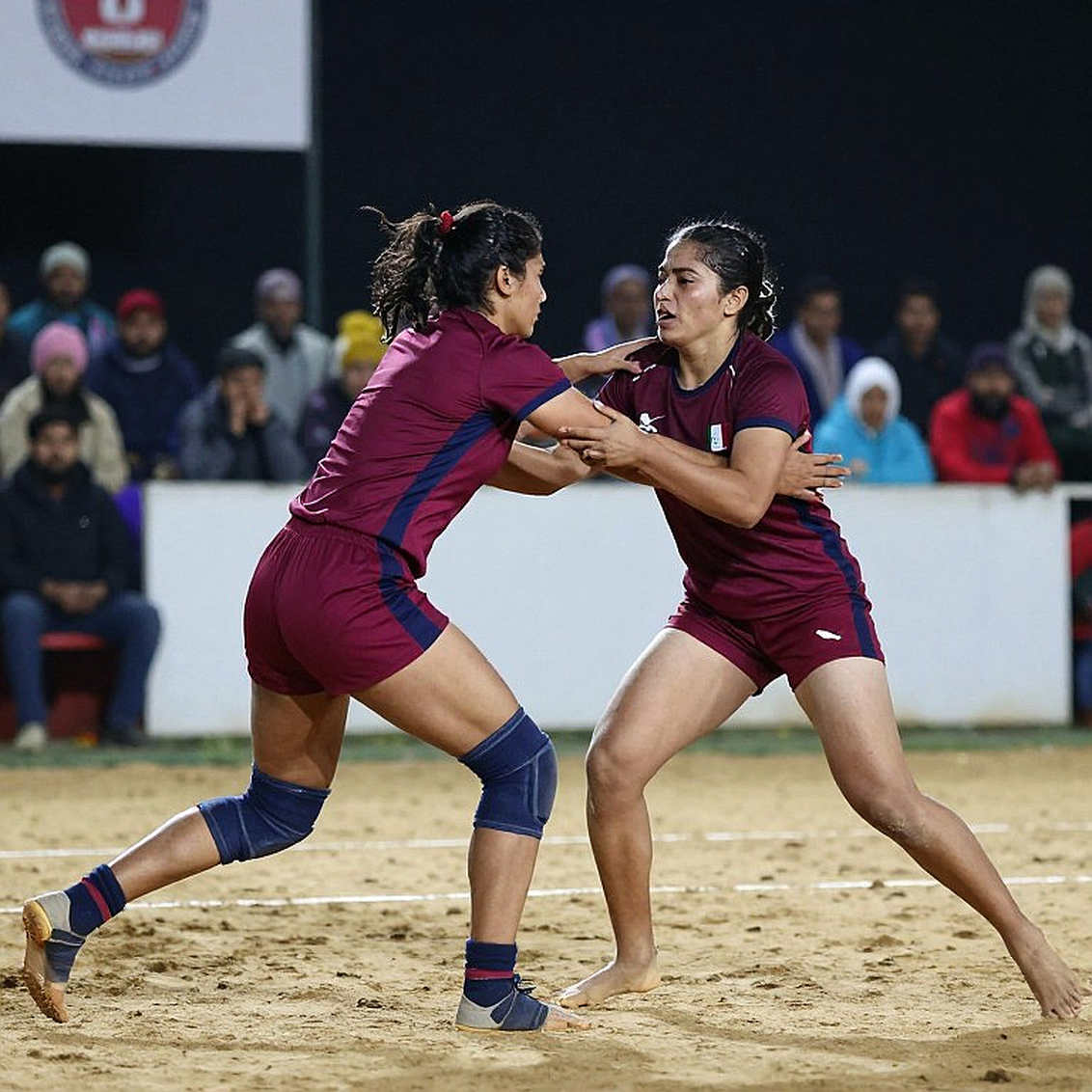
One more thing is missing: who is the second raider after Naveen Kumar? The report makes Naveen the centre of India's 'raiding department' but does not publish a squad list. In kabaddi, an attack dependent on one raider collapses quickly against a chain-tackle scheme. If Naveen is stopped, injured, or has an off day, who takes over the scoring? The report does not answer. Raid points, tackle points, success rates, match counts—not one number appears. The PKL has India's cleanest kabaddi data after cricket, yet this preview runs without a single figure.
I pulled the 2026 Dubki tape expecting chaos. I found a thesis. That year in Chennai, Patna Pirates beat Jaipur Pink Panthers 55-38 and Pardeep Narwal finished the season with 369 raid points. I was in Bengaluru studying biomechanics and started a raid-outcome sheet instead of watching highlights—to count which escape carried what risk. The habit still works: one checkable number first, then the nerve, then the take. This report is missing the first part.
The second big story is the women's competition—and the report finishes it in one sentence. There are four paragraphs on the men's captaincy; the women's event gets a mention that it will exist. Who is the women's captain? Squad? Coach? Format? Nothing. That coverage asymmetry is itself a data point. The Indian kabaddi media ecosystem still treats the women's game as an add-on. Yet the most solid structural contribution of this event may be exactly that: an international women's draw, which the PKL does not provide because it has no women's league.
Ahmedabad as host is also a signal. Gujarat is not a traditional kabaddi talent heartland—Haryana, Maharashtra, Punjab, UP and Tamil Nadu play that role. But Ahmedabad has a franchise footprint, stadium capacity and state-level sports infrastructure. Taking the first international event there is a market-expansion decision more than a talent-consolidation one. That is not wrong; calling it 'kabaddi's new centre' would be premature.
Calendar congestion is the most ignored tension here. The 2026 Asian Games sit in the September-October window, this championship runs 23-31 October, and the PKL's historical window is October-December. Calendar congestion is the real injury culprit; a medical team cannot remove the load of two matches a week. The report gives no tournament format, no number of teams, no sanctioning body and no broadcaster. This event is not part of the Commonwealth Games either; Glasgow 2026 does not include kabaddi. 'Commonwealth' here is a membership frame, not proof of competitive depth.
Now the part where I cut my own take. Suppose you argue: it is a new event, the international calendar needs such tournaments, there is a women's draw, Gujarat opens a new market, and immediately after the Asian Games it can give fringe players international tape. That is a strong case. If true, Surjeet's captaincy is developmental, not first-choice. India's real team will be at the Asian Games, not Ahmedabad. But the argument has a trap: without format, team count, broadcaster and squad, you cannot price this event. 'New event' is not a virtue by itself; kabaddi has seen events look big in press releases and small on tape.
The Jakarta physics thread began as a bar argument. Then the numbers landed. In 2026, India lost 18-27 to Iran, after a 23-24 group-stage defeat to South Korea. I wrote then that this was physics, not betrayal: Iran's wrestling-derived ankle holds and corner pressure had out-evolved an Indian selection picked on reputation. Fazel Atrachali's tackle-point record is the receipt. After that day I deleted 'guaranteed gold' from my vocabulary. So calling Iran's absence here an 'easy draw' is fair; calling it proof of India's strength is not. The world's real co-favourite is Iran; this event does not have them.
When the first raid happens on 23 October, watch four things beyond the scoreboard: the playing seven, the women's captain, the tournament format and the broadcaster. If those four arrive, Ahmedabad can become a new door for kabaddi. If they do not, the Surjeet-Naveen pairing will remain a good press release, not a competitive benchmark. The hot take is easy. The tape is where the argument earns its keep.